Should You Memorize the Quran From the Start or the End?
Juz Amma first or Surah Al-Baqarah first? The two conventions, who each one suits, and why most teachers use a hybrid of the two.
Nearly every new Hifz student asks this, and gets a confident answer that contradicts the confident answer they got last week. Both conventions are legitimate and long-established. They suit different students, and the right question is not which is better but which fits the person memorizing.
The two conventions
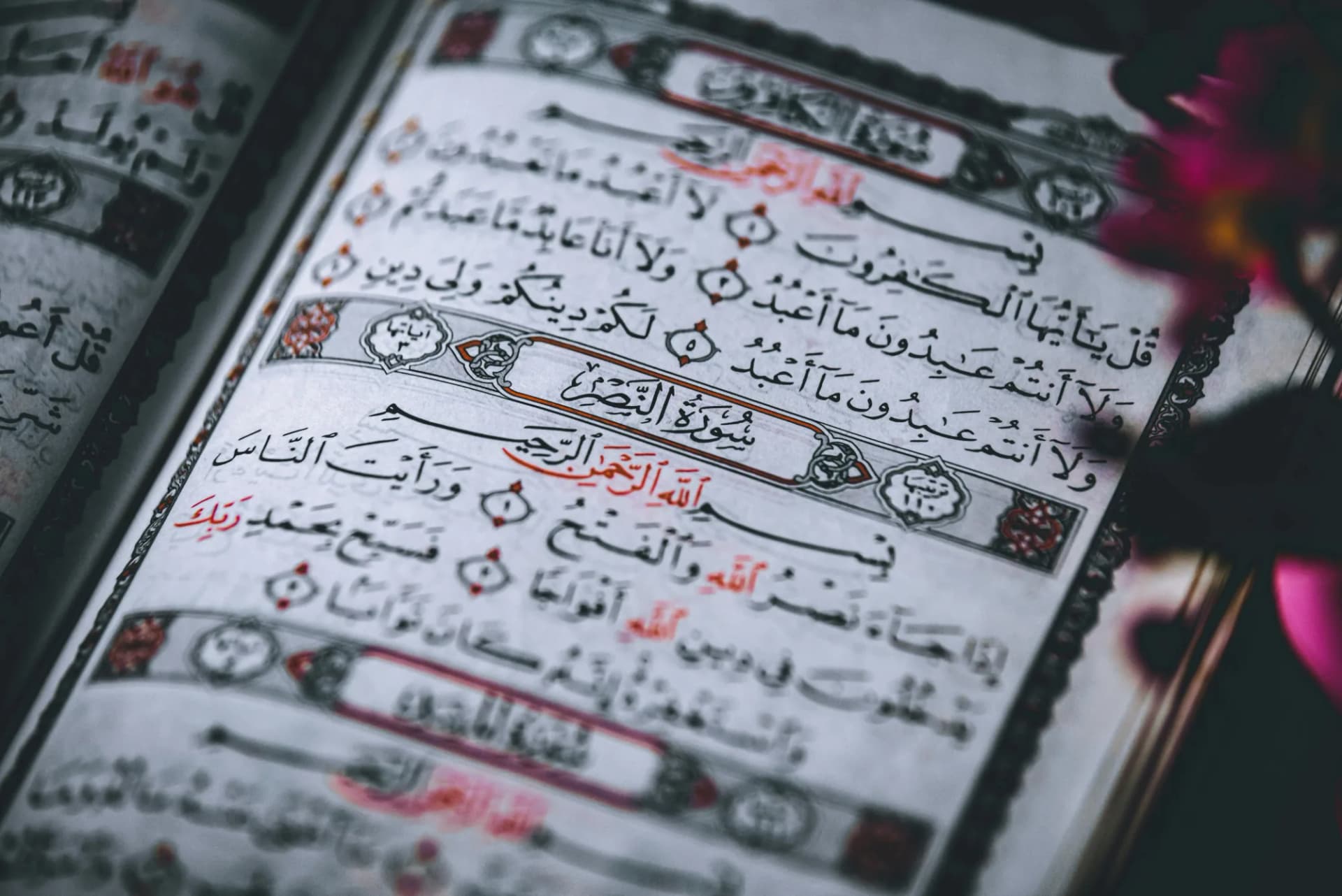
Back-to-front means starting at the end of the mushaf — Surah An-Nas, Al-Falaq, Al-Ikhlas — and working forward through Juz Amma (Juz 30), then Juz 29, and so on toward the beginning.
Front-to-back means starting at Surah Al-Baqarah and working through the Quran in order, usually after Al-Fatihah.
Note that back-to-front does not mean reciting the Quran backwards. It means choosing the order in which you memorize. The Quran's own order is untouched.
Why back-to-front is the default
The surahs are short
Juz 30 contains 37 surahs across about 23 pages. Surah Al-Baqarah alone runs roughly 48 pages. For a beginner, finishing a whole surah in two days is worth more than the page count suggests — it converts an abstract, enormous project into a series of completions.
You already know them
If you pray, you have heard Al-Ikhlas, Al-Kawthar and An-Nasr thousands of times. Partial familiarity does a surprising amount of the work: you are firming up something half-known rather than building from nothing. This advantage disappears entirely in the middle juz.
They are immediately useful
Memorize Juz Amma and you can lead prayer, vary your recitation, and use what you have learned every day. That daily use is revision, which is why Juz Amma tends to stay solid long after other portions have decayed.
The momentum matters
The first three months decide whether most students continue. Back-to-front front-loads visible progress into exactly the window where motivation is most fragile.
Why some adults start from the beginning
Meaning carries you
Al-Baqarah, Aal-Imran and An-Nisa contain extended narrative and legal passages. A reader who understands Arabic — or who studies the meaning alongside — can lean on the thread of the argument. Comprehension is a genuine memory aid, and it is an advantage adults have that children usually do not.
The hardest material while you are freshest
The long middle juz are the most demanding part of the Quran to memorize. Starting there means meeting them with maximum enthusiasm and minimum revision load, rather than at year three when both have reversed. There is a real argument for spending your easiest months on your hardest pages.
No awkward handover
Students who go back-to-front reach a point — usually around Juz 25 — where the surahs lengthen sharply and the familiarity bonus runs out. It can feel like hitting a wall. Front-to-back has no such transition; the difficulty is high from the start and gradually eases.
The hybrid most teachers actually use
In practice the common approach is neither pure form:
- Memorize Juz 30 (Juz Amma) first. Three to six months for most students. Builds the habit, the technique and the revision rota on forgiving material.
- Then start at Surah Al-Baqarah and work forward. By now you have a working method and a functioning revision routine, which is exactly what the long surahs demand.
- Some add Juz 29 and Surah Al-Mulk, Yaseen and Ar-Rahman between the two phases, as they are commonly recited and worth having early.
This captures the early momentum of back-to-front and then takes the long material while there is still plenty of road ahead.
Which should you choose?
| If you are… | Start | Because |
|---|---|---|
| A child under about 12 | Juz Amma | Short surahs, frequent completions, immediate use in prayer |
| A beginner, any age | Juz Amma | Builds method and routine on forgiving material |
| Still building reading fluency | Juz Amma | Short passages make decoding errors cheap to fix |
| A fluent reader who knows Arabic | Al-Baqarah | Meaning aids recall; hardest pages while freshest |
| Returning after a long gap | Juz Amma | Rebuilds confidence fast on half-remembered ground |
| Aiming at a fixed deadline | Hybrid | Early momentum, then the bulk tackled early |
The thing that actually matters
Far more Hifz is lost to switching than to choosing wrong. A student who restarts three times — Juz Amma, then Al-Baqarah, then back to Juz Amma under new advice — has spent a year producing three partial beginnings and one revision rota that covers none of it properly.
Pick one. Commit for at least a year. Either convention, followed consistently with a working revision rota, beats the theoretically optimal order abandoned every spring.
Either order, same arithmetic: the Hifz timeline calculator gives you the timeline for the pace you can actually keep. Course: Hifz classes for adults.
Next in this cluster: How long does it take to memorize the Quran? · How to choose a mushaf for Hifz